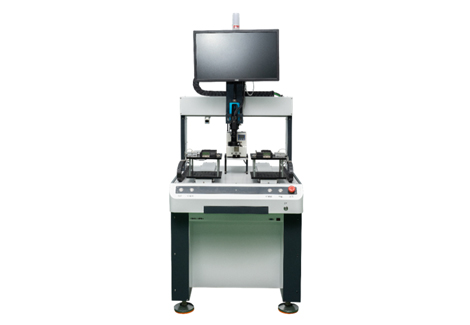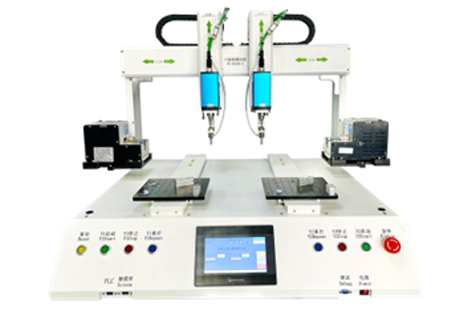

Automating micro-screw fastening in electronics assembly requires more than simply replacing manual tools with an automated screwdriver. To reduce defects, manufacturers must control screw feeding, positioning accuracy, torque application, and process verification as one integrated system.
An automatic screw driving machine can improve productivity and consistency when it is properly matched with screw size, product structure, and assembly requirements. For high-precision electronics, a vision-guided screwdriving machine provides additional control by identifying screw locations and compensating for positioning variations. For smaller production lines or flexible assembly stations, a desktop automatic screwdriving machine offers a practical balance between automation efficiency and investment cost.
The key to successful micro-screw automation is not only increasing speed, but maintaining stable fastening quality while preventing stripped threads, missing screws, and component damage.
Micro screws create unique challenges because their small size leaves very little tolerance for feeding and fastening errors.
Compared with standard industrial screws, micro fasteners often have:
Very small diameters and short lengths
Lightweight structures
Limited thread engagement depth
Sensitive surface finishes
Narrow installation spaces
In electronics manufacturing, these screws are commonly used in smartphones, laptops, cameras, wearables, medical electronics, and precision devices. A minor fastening error can lead to housing gaps, loose components, damaged circuit boards, or product reliability issues.
Small screws are more difficult because the margin for error becomes extremely narrow. A slight deviation in screw position, excessive torque, or unstable feeding can create defects that are difficult to detect after assembly.
Successful automation requires precise coordination between:
Screw feeding technology
Vacuum or magnetic pickup method
Motion control accuracy
Torque control system
Product positioning fixture
Quality inspection process
The first challenge in micro-screw automation is delivering each screw to the driver reliably.
Small screws are easily affected by:
Vibration
Static electricity
Surface oil contamination
Incorrect orientation
Insufficient feeding separation
An automatic screw driving machine uses an integrated feeder system to separate, orient, and deliver screws consistently to the screwdriver bit.
For micro screws, common feeding solutions include:
Vacuum pickup is widely used for lightweight and non-magnetic screws because it provides stable holding force without depending on screw material.
High-precision feeders guide screws into the correct position before pickup, reducing double feeding and missed pickup problems.
Micro screws often require customized:
Screw feeders
Bits
Nozzles
Guide systems
A properly designed feeding system prevents one of the most common automation problems: inconsistent screw availability.
Unstable feeding can cause:
Empty fastening cycles
Cross-threading
Screw drops inside products
Operator intervention
Reduced equipment utilization
For high-volume electronics production, feeding reliability is often the foundation of overall assembly performance.
Micro-screw fastening requires accurate positioning because electronic components typically have limited assembly tolerance.
Small electronic products often contain:
Narrow screw holes
Flexible plastic housings
Thin metal frames
Sensitive internal components
Even a small positional error can prevent proper thread engagement or damage surrounding components.
A standard automated screwdriver depends heavily on accurate fixture positioning. However, when product variation exists, a vision-guided screwdriving machine provides additional flexibility.
A vision system uses cameras and image processing to identify screw locations before fastening.
Benefits include:
Automatic screw hole recognition
Compensation for product positioning errors
Improved alignment accuracy
Reduced incorrect screw placement
This is especially valuable for products where:
Multiple models share the same production line
Screw positions vary slightly
Manual fixture adjustment is difficult
Vision guidance helps transform screwdriving from a fixed mechanical process into a more adaptive automation solution.
Torque control is one of the most critical factors in micro-screw assembly.
Because small screws have limited mechanical strength, excessive torque can cause:
Thread stripping
Plastic boss damage
Screw head deformation
Component stress
Insufficient torque can result in:
Loose assemblies
Product vibration problems
Reduced durability
An automatic screw driving machine improves torque consistency by using programmable torque control and monitoring systems.
Important control factors include:
Each screw type requires optimized torque parameters based on:
Screw material
Thread design
Product material
Required clamping force
Advanced systems can monitor:
Torque curve
Screw depth
Tightening time
Abnormal fastening conditions
For micro screws, vertical force must be carefully managed. Excessive pressure may damage delicate components, while insufficient pressure may cause poor thread engagement.
A stable combination of torque control, Z-axis motion control, and screw detection helps reduce assembly defects.
Choosing between a desktop automatic screwdriving machine and a vision-guided screwdriving machine depends on production requirements, product variation, and automation goals.
| Configuration | Best suited for | Main advantages |
|---|---|---|
| Desktop automatic screwdriving machine | Small and medium-volume electronics production | Compact design, easy operation, lower investment |
| Vision-guided screwdriving machine | High-precision and variable products | Automatic positioning, higher flexibility |
| Fully automated screwdriving system | Large-scale production lines | Maximum throughput and integration capability |
A desktop automatic screwdriving machine is suitable when:
Screw locations are fixed
Product models are limited
Operators need a simple automated workstation
Production volume does not require full-line automation
It provides better consistency than manual fastening while maintaining flexibility for smaller manufacturers.
A vision-guided screwdriving machine is preferred when:
Products have positioning variations
Multiple models share one line
Screw locations are difficult to fixture
Assembly accuracy requirements are high
Vision systems reduce dependence on mechanical positioning and help manufacturers maintain quality in complex electronics assembly.
Automating micro-screw fastening successfully requires more than increasing screwdriver speed. Manufacturers must create a balanced system that controls screw feeding, positioning accuracy, torque consistency, and defect prevention.
An automatic screw driving machine provides stable and repeatable fastening for high-efficiency electronics production. A desktop automatic screwdriving machine is an effective choice for compact workstations and flexible manufacturing environments, while a vision-guided screwdriving machine offers advanced positioning capability for complex and high-precision assemblies.
The right automation solution depends on screw size, product design, production volume, and quality requirements. When these factors are properly evaluated, micro-screw automation can improve productivity without increasing defect rates.
It is used to automatically feed, position, and tighten screws in electronics and precision assembly applications.
Their small size, low weight, and limited tolerance make feeding and positioning more challenging.
Use it when screw locations vary or when high positioning accuracy is required.
Yes. It is suitable for small and medium-volume production with fixed screw positions.
It improves torque control, screw positioning, and process repeatability compared with manual fastening.