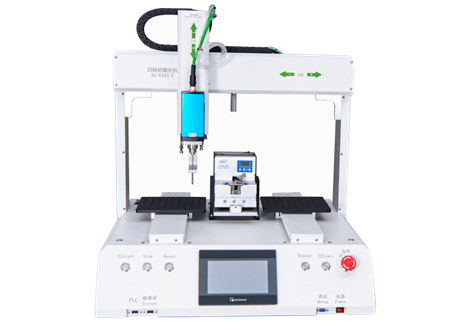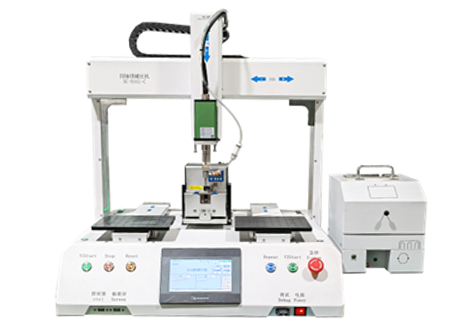

An automated screwdriver is a specialized tool designed to streamline the process of inserting screws into components during manufacturing and assembly. Engineered to meet the diverse needs of various production environments, these devices come in a range of sizes, designs, and capabilities, all focused on facilitating screw insertion with precision. By incorporating an automatic screw feeder, they enhance speed, accuracy, quality, and efficiency in modern production settings. The operation involves a seamless process where a self feeding screwdriver delivers screws into the tool, which then securely fastens them into an assembly. This is achieved through the coordinated effort of three key components: the screw driving unit for physical insertion, the controller for managing operations, and the automatic screw feeding system for consistent screw supply. In labor-intensive screwdriving scenarios, these tools significantly reduce costs. They are also highly cost-efficient in processes using the same screw type repeatedly, boosting productivity with minimal manual effort.
Automatic screwdrivers are essential for enhancing productivity, controlling process rates, and providing flexibility in manufacturing. This automatic screwdriver with feeder streamlines workflows by delivering consistent, accurate, and reliable fastening, surpassing manual methods. They operate swiftly and autonomously, driving thousands of screws with programmed torque settings and minimal human intervention, reducing errors and ensuring high-quality results. This makes them indispensable in industries like electronics, automotive, medical devices, and home appliances. When selecting a screwdriver with automatic screw feeder, key factors include the screwdriver mechanism and its delivery system, which may involve robotic arms or fixed installations. Available in forms like electric, pneumatic, torque-controlled, or programmable systems, these tools are tailored to specific automation needs, influenced by product size, production speed, and fastening precision. Manufacturers innovate continuously, developing custom systems with single or multi-spindle setups, smart controls, or vision-assisted technology to meet evolving industry demands and support smart manufacturing trends.
The gantry-style automatic screwdriver operates along X and Y axes, using a servo motor and sliding table system to position and fasten screws accurately. Equipped with robust rails and brackets, it ensures precise assembly placement and supports complex sequences in high-mix production environments. Compatible with an automatic feed screwdriver, it enables continuous operation but typically requires an operator for manual loading and unloading. Its portability allows repositioning or retrofitting, making it versatile for electronics, automotive, and industrial applications with varied fastener requirements. Torque monitoring and control, enabled by integrated sensors and digital controllers, ensure consistent torque and depth, reducing defective fastening and maintaining quality in industries with stringent tolerances.
Robotic screwdrivers, also known as robotic fastening systems, are designed for repetitive, precise screw insertion, optimizing efficiency and reducing labor costs. These systems integrate a robotic arm, a programmable screwdriver attachment, a machine vision system, a motion controller, and a user-friendly interface. The robotic arm's flexible joints enable precise screw placement across various product configurations, ideal for high-volume production in electronics, automotive, and consumer goods. Advanced vision systems ensure real-time alignment and defect-free fastening, supporting data-driven process optimization. The user interface allows programming of parameters like torque and screw type, often integrating with manufacturing systems for traceability. Compatible with an auto screw feeder machine, these systems are effective in both large-scale and flexible, low-volume production.
Collaborative robots, or cobots, combine human expertise with advanced automation, offering compact, affordable, and precise solutions for screwdriving tasks. Designed to work safely alongside operators, they feature safety sensors, force-limiting technology, and emergency stop functions. Their lightweight design and tool-less setup make them re-deployable, addressing workforce shortages and repetitive task fatigue while improving ergonomics. Equipped with an automatic screwdriver feeder, cobots handle complex assemblies in industries like electronics and medical devices. Smart torque-sensing and auto-adjust grip modules enhance their capability, while humans manage exception tasks or quality checks, creating a synergistic process that minimizes errors and ensures reliable fastening.
Automatic tool changer screwdrivers support flexible manufacturing by handling multiple screw types and geometries without manual retooling. These systems use modular feed mechanisms and quick-change tool heads, often paired with an automated screw feeder, to switch seamlessly between screwdriver heads for diverse product variants. Beyond screwdriving, they perform tasks like component placement, expanding their role in assembly automation. Encoded selection mechanisms or RFID tagging prevent fastener mix-ups, while integrated sensors and safety features like light curtains ensure operator safety. These systems are critical in electronics, automotive, and aerospace, where flexibility and quality are paramount.
Multi-spindle automatic screwdrivers are engineered for high-volume production, inserting multiple screws simultaneously or in programmed sequences to maximize throughput. Each spindle is programmable for speed, torque, and sequencing, accommodating complex assemblies. Integrated with assembly automation screw feeders, such as high-speed blow feeders or vibration bowls, they handle various fasteners, including bolts and rivets, and are mounted on robotic arms or automated fixtures. This parallel processing reduces assembly time and ensures precise placement, with digital monitoring supporting traceability and quality control. These systems are ideal for mass production in electronics or automotive frame assembly, offering efficiency and consistent quality.
Automated screwdriving systems are advanced tools designed to optimize screw insertion in manufacturing, enhancing productivity, precision, and ergonomics. Comprising an automatic screw feeding machine, screwdriver unit, spindle, controller, and end effector, these systems deliver fast, consistent fastening. The feeder sorts and delivers screws, while the action unit positions and inserts them with precision. Advanced control systems monitor parameters like feed rate, torque, and depth, ensuring reliable fastening across industries like electronics and automotive. Integration with programmable logic controllers and human-machine interfaces aligns with Industry 4.0, enabling real-time monitoring and error-proofing for efficient assembly lines.
The automatic screw feeder ensures a high-speed supply of fasteners, using a hopper, selection mechanism, and vibratory bowl or rail to align and deliver screws. Advanced tracking prevents jamming, increasing uptime. Screws are presented via magnetic bits or vacuum systems, reducing cycle times. Configurations like bowl, rail, or tape feeders accommodate various screw sizes and geometries. Vacuum feeder systems, ideal for delicate electronics, use negative pressure for precise positioning, while multi-spindle setups synchronize with auto feeder screwdrivers to optimize high-volume production.
Screwdriver units, available in handheld, fixed, or robotic configurations, are designed for precision fastening. Equipped with high-torque motors and quick-change bit holders, they handle diverse screw types. Torque adjustment and feedback mechanisms ensure accurate insertion, critical for quality control. Handheld units suit small-batch tasks, while fixed units with vision-guided systems support large-scale production. Movable units, including cobots with an automatic screw feeder, offer flexibility for dynamic tasks, supporting multi-point or angled insertions in smart manufacturing systems.
The spindle, the core of the screwdriving mechanism, rotates and secures fasteners with precise force and torque. Powered by servo or brushless motors, spindles feature sensors for real-time torque and depth monitoring, ensuring quality and traceability. Designs range from compact units for electronics to heavy-duty models for industrial applications, with programmable settings adapting to different screws. Features like stroke compensation prevent overtightening, and electric spindles support smart factory automation with low maintenance.
The controller manages screw feed, spindle speed, torque, and depth through microprocessors or embedded software. Featuring touchscreen interfaces, data logging, and integration with manufacturing systems, controllers enable real-time monitoring and anomaly detection. They trigger alerts for issues like feeder jams, supporting predictive maintenance and traceability in Industry 4.0 environments, ensuring high-quality assembly and operational efficiency.
The end effector, or gripper, is the critical interface in robotic screwdriving, manipulating and driving screws with precision. Engineered for flexibility, modern effectors handle various screw sizes without manual changes, using sensors and anti-cross-threading technologies. Programmable axes enable complex insertions, while error-detection ensures reliable fastening. Paired with an automatic screw feeding system, effectors enhance agility, reduce labor costs, and ensure consistent quality in high-mix production.
The performance of automatic screwdrivers depends on their power source, which influences accuracy, speed, and torque. Electric and pneumatic systems are the primary options. Electric screwdrivers, often paired with an auto screw feeder machine, offer programmable torque and speed settings, adjusted in real-time via sensors for precise fastening. Transducers measure torque, enhancing flexibility despite higher costs. Pneumatic screwdrivers, powered by compressed air, use vane motors and clutches for preset torque levels. Known for their power-to-weight ratio and low maintenance, they integrate with automatic screw feeder suppliers for rapid assembly in diverse manufacturing environments.
Screw feeders ensure a steady supply of screws, minimizing cycle times by accurately positioning them for insertion. Designed to handle complex picking and orienting tasks, they use magnetic bits or vacuum systems and are built from durable materials like steel or aluminum. Configurations like bowl, rail, and hopper feeders, often sourced from automatic screw feeder suppliers, cater to various screw sizes and production needs with anti-jam mechanisms for reliability.
Vibratory bowl feeders efficiently orient and deliver bulk screws to the auto feeder screwdriver using electromagnet-generated vibrations. These compact systems handle a wide range of screw sizes, ideal for electronics and automotive assembly where space and efficiency are critical.
Hopper feeders combine a storage hopper with a conveyor or rail, releasing screws one at a time via vibrations or pneumatic mechanisms. They ensure continuous operation and smooth integration into high-speed production lines with an automatic screw feeding machine.
Vacuum-based feeders use negative pressure to position screws precisely, ideal for non-magnetic materials and delicate assemblies. Adjustable nosepieces accommodate various screw types, enhancing precision in confined spaces and reducing assembly time.
Screw presenters are compact, affordable systems that position screws on a flat surface for easy pickup by a screwdriver with automatic screw feeder. Designed for smaller-scale operations, they offer precision and convenience for workbench tasks requiring accurate joint securing.
Step screw feeders use a stepped mechanism to elevate screws onto a vibratory conveyor, ensuring proper alignment. Their vibration minimizes friction, making them suitable for surface-coated screws in applications requiring gentle handling and precise feeding.
Automatic screwdrivers, often equipped with an automated screw feeder, have transformed manufacturing by enhancing efficiency, accuracy, and speed. Once labor-intensive, screw fastening is now streamlined, improving production rates and product quality through advanced automation.
Equipped with sensors, automatic screwdrivers ensure precise screw placement and angular alignment, enhancing joint quality and repeatability. This accuracy is critical for maintaining standards in industries like electronics and automotive.
With options from basic manual to advanced robotic systems, automatic screwdrivers offer tailored solutions. This variety ensures cost-effective automation, reducing labor expenses and supporting diverse production scales.
Automatic screwdrivers, paired with an automatic screw feeder, drastically reduce assembly times by streamlining screw selection, insertion, and tightening. Tasks that took hours are completed in minutes, boosting productivity.
Available in various configurations, automatic screwdrivers cater to large-scale production and smaller tasks. Manufacturers customize solutions to meet specific requirements, ensuring compatibility with diverse environments.
By automating repetitive tasks, these systems reduce worker fatigue and injury risks, improving safety and morale. This focus on ergonomics enhances productivity and supports a healthier workforce.
Automatic screwdriving systems, integrating assembly automation screw feeders, controllers, and screwdriver units, deliver precise, efficient fastening in manufacturing. Their adaptability suits diverse applications, from custom assemblies to high-volume production. Renowned for accuracy, speed, and high-quality output, these systems, powered by electricity or compressed air, offer varying cost and flexibility. Built for harsh manufacturing conditions, they securely fasten single or multiple screws, meeting complex industrial demands while enhancing efficiency and product quality.