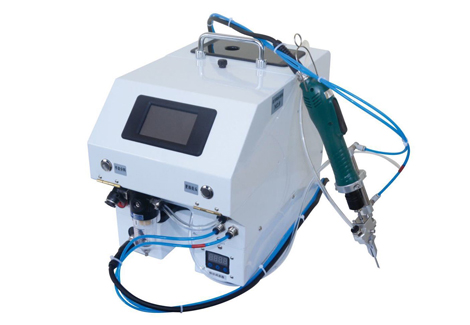

Choosing the right automatic feeder screwdriver machine is not only a purchasing decision. For manufacturers, it directly affects assembly speed, screw fastening quality, labor efficiency, product consistency, and long-term production stability. A suitable system can help production lines reduce manual work, improve torque accuracy, prevent missing screws, and support higher output. A poorly selected machine, however, may cause screw jams, unstable cycle times, frequent downtime, and higher maintenance costs.
This guide explains how to evaluate an auto screw feeder machine from production needs, screw specifications, feeding methods, robot configuration, AI vision, ROI, and supplier capability.
An auto screw feeder machine is an industrial automatic screw fastening system designed for production lines. It is different from a handheld electric screwdriver used in manual assembly. A complete system usually combines screw feeding, screw picking, precision tightening, motion control, vision positioning, PLC control, and HMI operation. The machine can automatically sort, orient, transport, position, and tighten screws with minimal human intervention.
A typical automatic screw fastening system may include:
| Module | Main Function |
|---|---|
| Screw feeder unit | Sorts and supplies screws continuously |
| Screwdriver module | Tightens screws according to torque settings |
| Motion platform or robot | Moves the screwdriver to each fastening point |
| Vision system | Locates workpieces and checks screw positions |
| PLC and HMI control | Manages operation, parameters, alarms, and data |
| Error detection system | Detects missing screws, floating screws, slipping, and torque errors |
For modern assembly lines, an automatic screwdriving machine is especially useful when products require stable torque control, repeatable fastening, and high-volume production.
The wrong automatic feeder screwdriver machine can create several problems after installation. Robots may wait for screws, feeders may jam frequently, screws may fail to reach the fastening position, or torque may become unstable. These issues can reduce production efficiency and affect overall equipment effectiveness.
In contrast, the right system can help manufacturers achieve:
More stable cycle time
Lower dependence on manual operators
Better screw fastening consistency
Fewer missing screws and fastening defects
Easier quality traceability
Better compatibility with future automation upgrades
Higher production capacity with less rework
For production line projects, early selection has a direct impact on whether the automation investment succeeds in the long term.
Before comparing suppliers or machine prices, manufacturers should first clarify their real production requirements. The best automatic screw feeder screwdriver machine depends on the product, screw type, assembly process, and target output.
Key production factors include:
| Selection Factor | Why It Matters |
|---|---|
| Screw diameter and length | Determines feeder compatibility and feeding stability |
| Screw material | Affects magnetic feeding, vacuum pickup, and wear |
| Screw head style | Influences bit selection and fastening accuracy |
| Workpiece material | Plastic, metal, PCB, and fragile components need different torque control |
| Fastening position | Deep holes, side holes, and angled positions require different robot structures |
| Production volume | High-volume lines need faster and more automated configurations |
| Cycle time target | Determines whether blow feed, vacuum feed, or multi-axis solutions are needed |
| Product changeover frequency | Affects fixture design, software settings, and vision flexibility |
For example, electronics assembly often requires small screws, precise torque, and vision positioning. Automotive and home appliance production may require stronger torque, larger screws, and more durable machine structures.
The feeding method is one of the most important parts of an auto screw feeder machine. It determines how screws are delivered from the feeder to the screwdriver head.
A blow feed system uses compressed air to send screws through a tube to the screwdriver head. It is suitable for high-speed production lines where cycle time is critical.
This method is commonly used when screw size is stable, production volume is high, and the fastening points are repetitive.
Best for: high-speed assembly, stable screw types, mass production
Main advantage: faster screw delivery and shorter cycle time
A vacuum feed system uses suction to pick and hold screws. It is suitable for small screws, deep holes, narrow spaces, and applications that require careful positioning.
This method is often used in electronics, precision instruments, PCB assemblies, and compact product structures.
Best for: small screws, deep-hole fastening, delicate components
Main advantage: better positioning control for precision applications
A magnetic feed system is a simpler option for standard metal screws. It is suitable when the product structure is not too complex and the main priority is stable fastening at a reasonable cost.
However, it is not suitable for non-magnetic screws or some precision applications where magnetic interference must be avoided.
Best for: standard metal screws and general industrial fastening
Main advantage: simple structure and reliable operation
The motion structure determines how the screwdriver reaches different fastening points. When selecting an automatic screwdriving machine, manufacturers should choose the robot or platform according to product layout and fastening direction.
A Cartesian platform is suitable for products with fixed positions and relatively simple layouts. It is commonly used for flat workpieces and repeatable fastening patterns.
Best for: fixed products, simple screw layouts, stable production lines
A SCARA robot is suitable for fast horizontal movement. It is often used in electronics, small appliances, and high-speed assembly applications.
Best for: fast planar movement, high-speed fastening, compact workstations
A 6-axis robot is more flexible and can handle complex angles, curved surfaces, side fastening, and varied product orientations.
Best for: complex structures, angled fastening, multi-model production
For high-mix production, robot flexibility and software programmability are especially important. For single-product mass production, a simpler platform may be more cost-effective.
When comparing different automatic feeder screwdriver machine options, manufacturers should not focus only on purchase price. Technical performance determines whether the machine can run stably in daily production.
Important specifications include:
| Specification | What to Check |
|---|---|
| Torque range | Whether it matches your screw and material requirements |
| Torque accuracy | Whether fastening quality can remain consistent |
| Repeatability | Whether the machine can maintain stable positioning |
| Screw size range | Whether it supports current and future screw models |
| Feeding speed | Whether it meets your cycle time target |
| Vision resolution | Whether it can identify workpiece offsets and screw positions |
| Error detection | Whether it detects missing screws, floating screws, and torque failure |
| PLC compatibility | Whether it can connect with existing production equipment |
| MES compatibility | Whether it supports production data tracking |
| Changeover speed | Whether operators can switch products efficiently |
| Maintenance access | Whether cleaning, adjustment, and part replacement are convenient |
| Spare parts supply | Whether key parts can be delivered quickly |
Before buying, it is strongly recommended to test the machine with actual screw samples and real workpieces. Sample testing can reveal feeding problems, positioning risks, torque issues, and product-specific limitations before installation.
AI vision is becoming more important in automatic screw fastening systems. A vision-guided automatic screwdriving machine can locate workpieces in real time, compensate for position deviations, verify screw placement, and improve traceability.
AI vision can help with:
Workpiece positioning
Screw hole identification
Offset compensation
Missing screw detection
Wrong position detection
Screw presence verification
Quality data recording
Production traceability
This is especially useful for high-mix production lines where product sizes, screw positions, or fixtures may change frequently. With vision guidance, the machine can reduce dependence on extremely precise fixture positioning and improve production flexibility.
The ROI of an automatic feeder screwdriver machine should not be calculated only by comparing equipment cost with labor cost. A more practical ROI analysis should include productivity, quality, maintenance, and long-term scalability.
Manufacturers should consider:
Labor savings
Higher production output
Reduced rework
Lower defect rate
More stable torque quality
Less operator training time
Reduced material waste
Better traceability
Lower downtime after process stabilization
Easier production expansion
In many cases, the strongest ROI comes from production lines where automation improves both output and quality at the same time. If a manual process causes frequent missing screws, unstable torque, or rework, an automatic solution may create value beyond direct labor replacement.
Many automation projects face problems because the machine was selected too quickly. Common mistakes include:
Focusing only on the lowest purchase price
A cheaper machine may cost more later if it causes downtime, feeding jams, or poor fastening quality.
Skipping real screw sample testing
Screw size, coating, head shape, and material can all affect feeding stability.
Ignoring future product changes
If the product design changes later, the machine may not support new screws or fastening positions.
Underestimating software and traceability
Modern production lines often need data recording, alarm history, production statistics, and MES connection.
Choosing a supplier without strong support
Spare parts, training, technical service, and response speed are critical after installation.
Using the wrong feeding method
Blow feed, vacuum feed, and magnetic feed systems are suitable for different applications. The wrong choice may cause unstable performance.
Kingdom provides automatic screw fastening solutions for electronics, automotive, home appliances, and other industrial sectors. Its systems are designed to support different production line needs, from manual-assisted workstations to fully automated screwdriving cells.
Kingdom’s automatic feeder screwdriver machine solutions can support screw compatibility from M0.6 to M6, AI-powered vision guidance, smart error detection, real-time production analytics, and flexible system integration.
For different application scenarios, Kingdom can provide:
Handheld screwdrivers for flexible workstations and manual-assisted assembly
Automatic screwdriving machines for high-volume production lines
Pneumatic screwdriving machines for heavy-duty fastening
Vacuum-fed screwdriving systems for small screws and deep-hole applications
Magnetic screwdriver machines for standard industrial fastening tasks
Customized automatic screw fastening systems for specific production lines
For manufacturers planning to upgrade from manual fastening to automated assembly, Kingdom can help evaluate screw samples, workpiece structure, production targets, and automation requirements before recommending the right solution.
Before making a final decision, use this checklist:
What screw size, length, material, and head type will be used?
Is the screw magnetic or non-magnetic?
Are the fastening points flat, deep, angled, or difficult to reach?
What is the required cycle time?
What torque range and torque accuracy are required?
Does the production line need vision positioning?
Does the system need PLC, MES, or data traceability?
How often will the product model change?
Has the supplier tested real screw and workpiece samples?
Are training, spare parts, and technical support available?
A reliable automatic screw feeder machine should not only tighten screws. It should fit the production process, support stable operation, reduce defects, and create long-term value for the factory.
An auto screw feeder machine mainly focuses on sorting and supplying screws automatically. An automatic screwdriving machine usually includes screw feeding, positioning, tightening, torque control, and motion control. In many production line systems, both functions are integrated into one automatic screw fastening solution.
Blow feed systems are usually better for high-speed production because compressed air can move screws quickly through feeding tubes. However, the final choice still depends on screw size, screw shape, workpiece structure, and cycle time requirements.
A vacuum-fed system is suitable for small screws, deep holes, narrow spaces, and delicate components. It is commonly used in electronics, PCB assemblies, precision instruments, and compact product designs.
Some machines can support multiple screw sizes, but changeover depends on the feeder design, screwdriver module, bit, tube, and software settings. Before purchasing, manufacturers should confirm both current and future screw compatibility.
AI vision helps the machine locate workpieces, compensate for position offsets, verify screw placement, detect missing screws, and record quality data. It improves flexibility and traceability, especially in high-mix production environments.
ROI should include labor savings, higher output, reduced defects, less rework, lower downtime, and better production traceability. For high-volume production lines, the value of improved quality and stable cycle time can be as important as labor reduction.