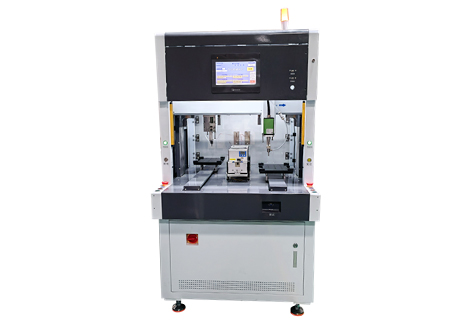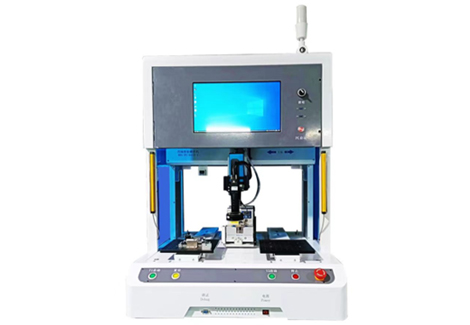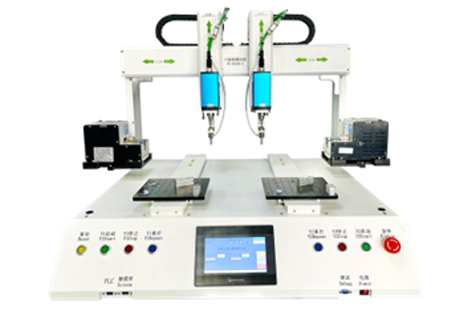

Choosing between a screw fastening robot and a Cartesian screwdriving machine depends on production requirements, product variation, fastening-point layout, and automation goals. A Cartesian system is usually the better choice for stable, high-volume production with fixed screw positions, while a robotic screw driving solution provides greater flexibility for complex products, multiple fastening angles, and frequent product changes.
Both systems can improve assembly efficiency, reduce labor dependency, and increase fastening consistency. However, their mechanical structures and automation capabilities are designed for different manufacturing environments.
The main difference is movement flexibility.
A Cartesian screwdriving machine uses linear motion axes, typically X, Y, and Z, to move the screwdriver along predefined paths. It operates within a fixed working area and is optimized for repeatable fastening operations.
A screw fastening robot uses an industrial robotic arm with multiple joints, allowing movement in several directions and angles. This enables the screwdriver to approach fastening points from different orientations.
The key differences include:
| Feature | Screw Fastening Robot | Cartesian Screwdriving Machine |
|---|---|---|
| Movement method | Multi-axis robotic arm | Linear X/Y/Z positioning |
| Flexibility | High | Moderate |
| Setup complexity | Higher | Lower |
| Product changeover | Faster for varied products | Better for fixed products |
| Space utilization | Compact working footprint | Larger fixed structure |
| Best application | Complex assemblies | High-volume repetitive assembly |
A Cartesian system excels when the product design is stable and screw locations remain unchanged. A robotic screw driving system becomes more valuable when manufacturers need adaptability.
Robotic screw driving allows manufacturers to program different fastening sequences, positions, and angles without major mechanical modifications.
This is especially useful for:
Multiple product models on one production line
Irregularly shaped components
Products with screws located on different surfaces
Assemblies requiring angled fastening
Frequent production changeovers
With advanced programming, one robotic system can handle several product variations while maintaining consistent torque control and fastening quality.
Product variation is one of the most important factors when selecting an automation platform.
A Cartesian screwdriving machine is highly efficient for dedicated applications. Once configured, it provides excellent repeatability and fast cycle times. However, adapting it to a new product may require:
Mechanical fixture changes
Axis travel adjustments
New tooling design
Additional programming
For manufacturers producing the same product for years, this investment is often worthwhile.
A screw fastening robot offers easier adaptation because changes are mainly handled through:
Robot program updates
Tooling adjustments
Fixture modifications
Vision system configuration
This makes robotic systems more suitable for industries with shorter product lifecycles.
Footprint depends on the application, but the two architectures use space differently.
Cartesian machines usually require a dedicated frame structure covering the working area. They are efficient in a fixed production cell but may occupy more floor space.
Robotic screwdriving systems often use vertical space more effectively. A compact robot arm can access multiple areas around a product while maintaining a smaller installation footprint.
For factories with limited floor space or flexible production layouts, robotic screw driving can provide greater layout advantages.
For simple, repetitive fastening tasks, Cartesian machines often achieve faster cycle times because their motion path is highly optimized.
Advantages include:
Straight-line movement
Short positioning distance
High repeatability
Dedicated operation sequence
For example, a product requiring four screws in fixed positions on a flat surface may be completed extremely efficiently using a Cartesian system.
However, speed is not determined only by movement. When products contain many screws positioned in different locations, robotic systems can reduce overall handling time.
A screw fastening robot can:
Rotate around the product
Access multiple sides
Adjust approach angles
Combine fastening and handling operations
This reduces the need for additional fixtures or manual repositioning.
Fastening-point layout is a critical selection factor.
Cartesian systems are ideal when:
Screw locations are arranged in a predictable pattern
Fastening surfaces are flat
Product orientation remains unchanged
Robotic screw driving is better when:
Screws are distributed across different surfaces
Fastening angles vary
The product requires multiple positioning steps
The assembly cannot easily be fixed in one orientation
The more complex the fastening path, the more advantages a multi-axis robot provides.
Not every robotic screw driving application requires vision. If parts are accurately positioned with dedicated fixtures, robot coordinates may be sufficient.
However, vision becomes valuable when dealing with:
Product position variation
Multiple product models
Loose positioning tolerances
Automatic part recognition
Flexible production lines
A vision-guided robotic system can identify screw locations and adjust the robot path automatically, reducing fixture dependency.
Cartesian systems typically rely more on precision fixtures and fixed positioning.
They are highly effective when:
Product placement is controlled
Components have consistent dimensions
Screw positions do not change
For high-volume production with stable processes, a fixture-based Cartesian system can provide excellent accuracy without additional vision complexity.
For flexible manufacturing environments, robotic systems combined with vision provide greater adaptability.
The right choice depends on production characteristics, not simply equipment type.
| Production Requirement | Recommended System |
|---|---|
| Single product, high output volume | Cartesian screwdriving machine |
| Fixed screw locations | Cartesian screwdriving machine |
| Multiple product models | Screw fastening robot |
| Frequent changeovers | Screw fastening robot |
| Complex screw positions | Screw fastening robot |
| Limited product variation | Cartesian system |
| Need for vision-based positioning | Robotic screw driving |
| Integration with flexible automation | Screw fastening robot |
A manufacturer should evaluate:
Annual production volume
Product lifecycle
Number of screw points
Screw position complexity
Required flexibility
Future product plans
Selecting a system based only on initial equipment cost may lead to higher long-term expenses if production requirements change.
A robotic screw driving system uses a multi-axis robot to position the screwdriver, providing flexibility for complex assemblies. An automatic screw driving machine is a broader category that includes Cartesian systems, robotic systems, and other automated fastening equipment.
Neither system is universally better. Cartesian machines are usually better for stable, high-volume production, while screw fastening robots are better for flexible manufacturing with product variation.
Yes. A screw fastening robot can store multiple programs and switch between different fastening sequences, making it suitable for mixed-model production.
Robotic screw driving improves consistency, reduces operator fatigue, controls torque more accurately, and provides production data for quality monitoring.
Both systems can provide high reliability when properly designed. Cartesian systems have simpler motion structures, while robotic systems provide greater flexibility. Reliability depends on tooling design, maintenance, and application requirements.
An automatic screw driving machine is beneficial when production volume is high, fastening quality is critical, labor costs are increasing, or manufacturers require repeatable torque-controlled assembly.
Yes. Modern robotic screw driving solutions can integrate electric screwdrivers, torque sensors, angle monitoring, and data collection systems to verify each fastening operation.
The choice between a screw fastening robot and a Cartesian screwdriving machine comes down to balancing flexibility, speed, and production stability.
For dedicated high-volume assembly lines with fixed screw locations, Cartesian systems provide excellent efficiency and repeatability. For manufacturers requiring flexible production, multiple product models, or complex fastening paths, robotic screw driving offers significant advantages.
Before investing in an automatic screw driving machine, manufacturers should analyze current production needs as well as future product changes. The right automation architecture can improve fastening quality, reduce operating costs, and create a more adaptable manufacturing process.